
Women in Translation Month: A Reading List

This Women in Translation Month, we're highlighting translated titles by women authors from our catalog to add to your shelves and reading lists this summer. To celebrate, we're offering 30% off all titles by women in translation through the end of August with the discount code WITMONTH.

Mariana Dimópulos
Translated from the Spanish by Alice Whitmore
“In her elegant short novel, Dimópulos explores the compromises a human being makes in taking on the identity and social role of a woman. With its caustic vignettes of male vanity and its subtle self-mockery, Imminence is playful on the surface, dark and disturbing in its depths.” —J.M. Coetzee, winner of the Nobel Prize for Literature
A new mother holds her month-old son for the first time, but her body betrays her with an absence of feeling. Disoriented, she wanders with her partner around their plant-filled Buenos Aires apartment. Set over the course of an evening, and a lifetime, Imminence shifts seamlessly between the present and the past. Little by little, her world begins to unravel.
In a dreamlike space composed of overlapping vignettes, Irina retraces the mirrored paths of a life filled with images that swell and recede, recalling the intimacies and anxieties she has shared with her female friends, and with her male lovers: Pedro, Ivan, and the sinister Cousin. Feeling herself caught in a web of obligations, she insists time and again: “I’m not a woman.”
Mariana Dimópulos’s mesmerizing novel reinforces her standing as one of the most expressive and inventive contemporary Latin American writers.
Imminence by Mariana Dimópulos (tr. Alice Whitmore)
A new mother holds her month-old son for the first time, but her body betrays her with an absence of feeling. Disoriented, she wanders with her partner around their plant-filled Buenos Aires apartment. In a dreamlike space composed of overlapping vignettes, Irina retraces the mirrored paths of a life filled with images that swell and recede. Set over the course of an evening, and a lifetime, Imminence shifts seamlessly between the present and the past.

Noémi Lefebvre
Translated from the French by Sophie Lewis
On a flight from Berlin to Paris, a woman haunted by German composer Arnold Schoenberg’s self-portrait reflects on her romantic encounter with a German-American pianist-composer. Obsessive, darkly comic, and full of angst, Blue Self-Portrait unfolds among Berlin’s cultural institutions, but is located in the mid-air flux between contrary impulses, with repetitions and variations that explore the possibilities and limitations of art, history, and connection.
Blue Self Portrait by Noémi Lefebvre (tr. Sophie Lewis)
On a flight from Berlin to Paris, a woman haunted by German composer Arnold Schoenberg’s self-portrait reflects on her romantic encounter with a German-American pianist-composer. Obsessive, darkly comic, and full of angst, Blue Self-Portrait unfolds among Berlin’s cultural institutions, but is located in the mid-air flux between contrary impulses, with repetitions and variations that explore the possibilities and limitations of art, history, and connection.

Dola de Jong
Translated from the Dutch by Kristen Gehrman
When Bea meets Erica at the home of a mutual friend, this chance encounter sets the stage for the story of two women torn between desire and taboo in the years leading up to the Nazi occupation of Amsterdam. Erica, a reckless young journalist, pursues passionate but abusive affairs with different women. Bea, a reserved secretary, grows increasingly obsessed with Erica, yet denial and shame keep her from recognizing her attraction. Only Bea’s discovery that Erica is half-Jewish and a member of the Dutch resistance—and thus in danger—brings her closer to accepting her own feelings.
First published in 1954 in the Netherlands, Dola de Jong’s The Tree and the Vine was a groundbreaking work in its time for its frank and sensitive depiction of the love between two women, now available in a new translation.
The Tree and the Vine by Dola de Jong (tr. Kristin Gehrman)
Elena Ferrante meets Patricia Highsmith’s The Price of Salt in this 1950s classic of repressed queer desire, set against the rising threat of WWII. A groundbreaking work in its time for its frank and sensitive depiction of the love between two women torn between desire and taboo in the years leading up to the Nazi occupation of Amsterdam.
“De Jong depicts the darker, dangerous side of the world of same-sex desire, and the way it’s a source of torment—physical and psychological—for those who exist within it.”—The Paris Review

BRIGITTE REIMANN
Translated from the German by Lucy Jones
A New Yorker Best Book of 2023
1960. The border between East and West Germany has closed. For Elisabeth, a young painter, the GDR is her generation’s chance to build a glorious, egalitarian socialist future. For her brother Uli, it is a place of stricture and oppression. Separating them is the ever-wider chasm of the Party line; over them loom the twin specters of opportunity and fear, and the shadow of their defector brother Konrad, prompting a clash between idealism and suppression, familial loyalty, and desire.
Considered a master of socialist realism, Brigitte Reimann (1933–1973) wrote irreverent, autobiographical works that addressed issues and sensibilities otherwise repressed in the GDR. She wrote in her diaries: “I enjoyed success too early, married the wrong man, and hung out with the wrong people; too many men have liked me, and I’ve liked too many men.” After her death from cancer in 1973 at the age of 39, she garnered a cult-like following. This is Reimann’s first work of fiction to appear in English.
Siblings by Brigitte Reimann (tr. Lucy Jones)
1960. The border between East and West Germany has closed. For Elisabeth, a young painter, the GDR is her generation’s chance to build a glorious, egalitarian socialist future. For her brother Uli, it is a place of stricture and oppression. Separating them is the ever-wider chasm of the Party line; over them loom the twin specters of opportunity and fear, and the shadow of their defector brother Konrad, prompting a clash between idealism and suppression, familial loyalty, and desire.
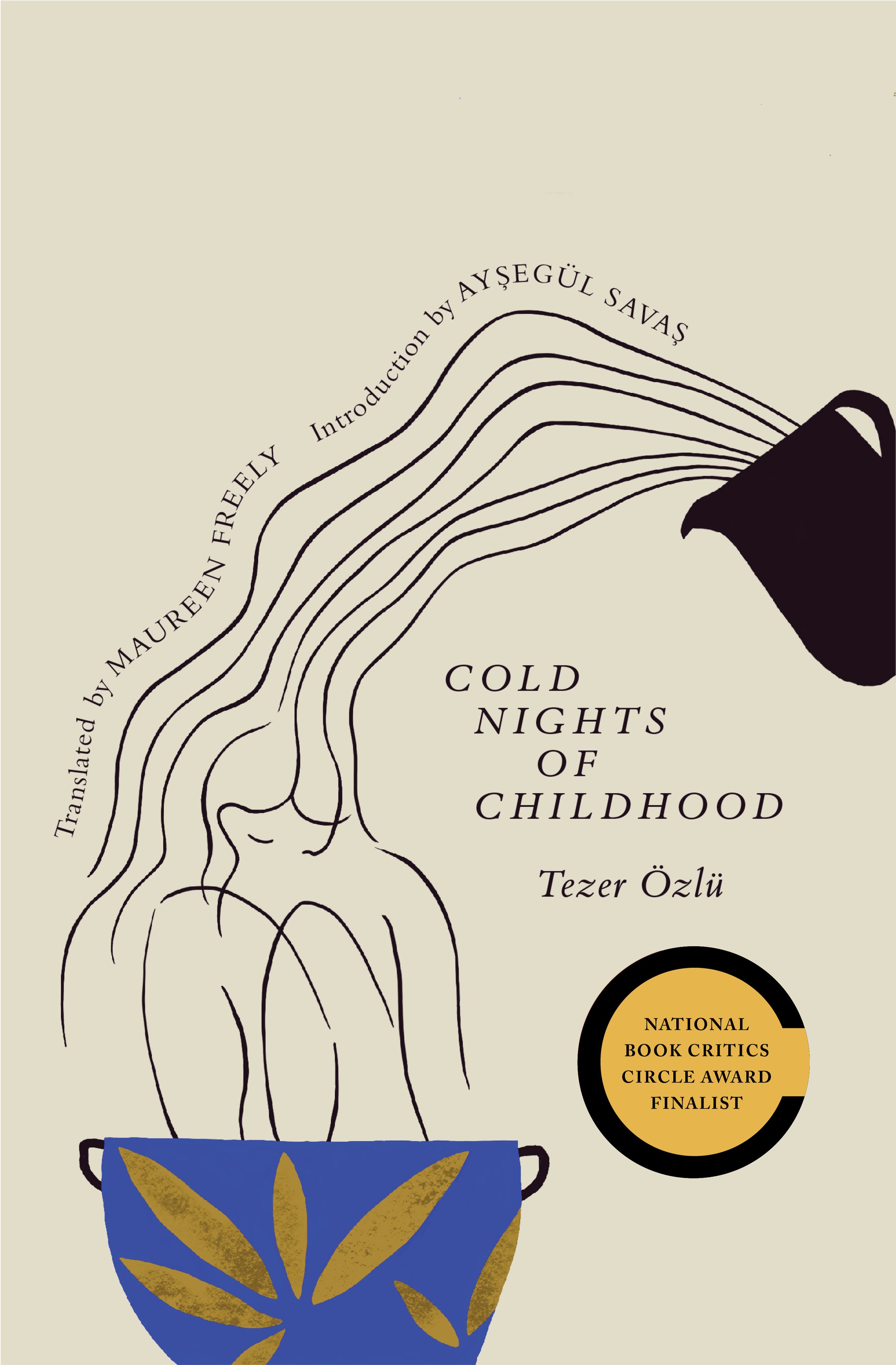
Tezer Özlü
Translated from the Turkish by Maureen Freely.
2023 National Book Critics Circle Award, winner
“A profoundly moving account of desperation, exhilaration, and endurance.”—Kirkus Reviews
The Bell Jar meets Good Morning, Midnight, by one of Turkey’s most beloved writers.
The narrator of Tezer Özlü’s novel is between lovers. She is in and out of psychiatric wards, where she is forced to undergo electroshock treatments. She is between Berlin and Paris. She returns to Istanbul, in search of freedom, happiness, and new love.
Set across the rambling orchards of a childhood in the Turkish provinces and the smoke-filled cafes of European capitals, Cold Nights of Childhood offers a sensual, unflinching portrayal of a woman’s sexual encounters and psychological struggle, staging a clash between unbridled feminine desire and repressive, patriarchal society.
Originally published in 1980, six years before her death at 43, Cold Nights of Childhood cemented Tezer Özlü’s status as one of Turkey’s most beloved writers. A classic that deserves to stand alongside The Bell Jar and Jean Rhys's Good Morning, Midnight, Cold Nights of Childhood is a powerfully vivid, disorienting, and bittersweet novel about the determined embrace of life in all its complexity and confusion, translated into English here for the first time by Maureen Freely, with an introduction by Aysegül Savas.
Cold Nights of Childhood by Tezer Özlü (tr. Maureen Freely)
Set across the rambling orchards of a childhood in the Turkish provinces and the smoke-filled cafes of European capitals, Cold Nights of Childhood offers a sensual, unflinching portrayal of a woman’s sexual encounters and psychological struggle, staging a clash between unbridled feminine desire and repressive, patriarchal society.

Carol Bensimon
Translated from the Portuguese by Beth Fowler
After a falling out, two friends reunite for a long-planned road trip through Brazil. As they drive from town to town, the complications of their friendship resurface. At the novel’s center is a romance, as Bensimon offers an intimate look into identity, love, and desire. By the end of the trip, the women must decide what the future holds, in a queer, coming-of-age debut novel that has been celebrated in Brazil.
We All Loved Cowboys by Carol Bensimon (tr. Beth Fowler)
Two women reunite after a falling out to embark on a long road trip through Brazil. Bensimon offers an intimate exploration of desire, identity, and the limitations and possibilities of female sexuality in this queer, Sad Girl coming-of-age road novel.
"This short but profoundly moving novel by the young Brazilian writer is one of the finest explorations of love you will find anywhere this year."—The Boston Globe
At Night He Lifts Weights by Kang Young-sook (tr. Janet Hong) (forthcoming)
An artist is plagued by desire for her mysterious double as disease spreads through an uncanny suburban landscape. An elderly woman suspects the old man who lifts weights in her neighborhood playground of being responsible for a spate of murders. While elsewhere, a woman who believes she’s been exposed to radioactive radiation inherits a warehouse where those fleeing the city can store their possessions. Beneath the calm surface of the stories collected here, Kang Young-sook offers a disquieting vision of a society grappling with ecological catastrophe and unplaceable forms of loss.

Noémi Lefebvre
Translated from the French by Sophie Lewis
A state of emergency has been declared in France. In Lyon, protesters and police clash in the streets. At the unemployment office, there are few job opportunities for poets going around. So the poet reads accounts of life under the Third Reich and in Nazi language, smokes cannabis, walks through the streets, and eats bananas, drawn by an overbearing father into a hilarious and often cynical exploration of the push to be employed and the pull to write. In this Oulipian experiment written without gender markers for its narrator, Noémi Lefebvre presents us with a comic and irreverent reckoning with the rise of nationalism and the hegemony capitalism has on our language, actions, and identities.
Poetics of Work by Noémi Lefebvre (tr. Sophie Lewis)
A state of emergency has been declared in France. In Lyon, protesters and police clash in the streets. At the unemployment office, there are few job opportunities for poets going around. So the poet reads accounts of life under the Third Reich and in Nazi language, smokes cannabis, walks through the streets, and eats bananas, drawn by an overbearing father into a hilarious and often cynical exploration of the push to be employed and the pull to write.

Mariana Oliver
Translated from the Spanish by Julia Sanches
Winner of the 2022 PEN Translation Prize
“Pondering revolutionary Cuba, the Berlin Wall, and the caves of Cappadocia, these essays explore themes of memory, war, movement, and home.”—The New Yorker
In her prize-winning debut, Mexican essayist Mariana Oliver trains her gaze on migration in its many forms, moving between real cities and other more inaccessible territories: language, memory, pain, desire, and the body. With an abiding curiosity and poetic ease, Oliver leads us through the underground city of Cappadocia, explores the vicissitudes of a Berlin marked by historical fracture, recalls a shocking childhood exodus, and recreates the intimacy of the spaces we inhabit. Blending criticism, reportage, and a travel writing all her own, Oliver presents a brilliant collection of essays that asks us what it means to leave the familiar behind and make the unfamiliar our own.
Migratory Birds is part of the Undelivered Lectures series from Transit Books.
Migratory Birds by Mariana Oliver (tr. Julia Sanches)
Moving through geographic and intellectual spaces with an abiding curiosity and poetic ease, Oliver presents a brilliant collection of essays that asks us what it means to leave the familiar behind and make the unfamiliar our own.
“Oliver debuts with a thoughtful, roving meditation on migration, language, and home. In intimate pieces studded with references to history and literature, Oliver ponders such topics as the tug of home and the consequences of dislocation... Fans of lyrical essays will enjoy this literary global odyssey.”—Publishers Weekly

Jacqueline Harpman
Translated from the French by Ros Schwartz
With an afterword by Sophie Mackintosh
Deep underground, thirty-nine women live imprisoned in a cage. Watched over by guards, the women have no memory of how they got there, no notion of time, and only a vague recollection of their lives before.
As the burn of electric light merges day into night and numberless years pass, a young girl—the fortieth prisoner—sits alone and outcast in the corner. Soon she will show herself to be the key to the others’ escape and survival in the strange world that awaits them above ground.
Jacqueline Harpman was born in Etterbeek, Belgium, in 1929, and fled to Casablanca with her family during WWII. Informed by her background as a psychoanalyst and her youth in exile, I Who Have Never Known Men is a haunting, heartbreaking post-apocalyptic novel of female friendship and intimacy, and the lengths people will go to maintain their humanity in the face of devastation. Back in print for the first time since 1997, Harpman’s modern classic is an important addition to the growing canon of feminist speculative literature.
I Who Have Never Known Men by Jacqueline Harpman (tr. Ros Schwartz)
Deep underground, thirty-nine women live imprisoned in a cage. Watched over by guards, the women have no memory of how they got there, no notion of time, and only a vague recollection of their lives before. As the burn of electric light merges day into night and numberless years pass, a young girl—the fortieth prisoner—sits alone and outcast in the corner. Soon she will show herself to be the key to the others’ escape and survival in the strange world that awaits them above ground.

Alejandra Costamagna
Translated from the Spanish by Lisa Dillman
PEN Translation Prize, Longlisted
Cat sitter, insomniac, former schoolteacher. Ania worries she is a “stand-in occupant,” a substitute in her own life. When she receives a request from her father to visit her dying uncle Agustín in Argentina, she makes the long journey across the Andes from Chile to Campana, where her family immigrated from Italy. Her trip, one she used to make every summer with her father, will be an escape from the present and a journey to the borders of memory.
What follows is an ambitious portrait of alienation and belonging, and of two families and countries separated by a range of mountains. Threaded together with encyclopedia entries, pages from an old immigrant manual, typing class exercises, half-faded photos, and letters mailed between continents, The Touch System introduces Alejandra Costamagna as one of the most powerful and subtle writers in contemporary Latin American literature.
The Touch System by Alejandra Costamagna (tr. Lisa Dillman)
An ambitious portrait of alienation and belonging, and of two families and countries separated by a range of mountains. Threaded together with encyclopedia entries, pages from an old immigrant manual, typing class exercises, half-faded photos, and letters mailed between continents, The Touch System introduces Alejandra Costamagna as one of the most powerful and subtle writers in contemporary Latin American literature.

Esther Kinsky
Translated from the German by Caroline Schmidt
Winner of the Leipzig Book Prize
Winner of the Düsseldorf Book Prize
An unnamed narrator, recently bereaved, travels to Olevano, a small village southeast of Rome. It is winter, and from her temporary residence on a hill between village and cemetery, she embarks on walks and outings, exploring the banal and the sublime with equal dedication and intensity. She recalls her travels in 1970s Italy, which she often visited as a child with her father. Fragmented impressions and memories—of Communist party rallies, roadside restaurants, film sequences, bird life, and the ubiquitous Etruscan necropoli—combine into a mosaic of a bygone era. Then the narrator visits Northern Italy, between Ferrara and the Po estuary, some years after the bereavement. She looks for the garden of the Finzi-Contini family, walks along deserted canals and explores abandoned seaside resorts. Seeing, describing, naming the world around her is her way of redefining her place within it. Written in a rich and poetic style, Grove is an exquisite novel of grief, love, and landscapes.
Grove by Esther Kinsky (tr. Caroline Schmidt)
An unnamed narrator, recently bereaved, travels to Olevano, a small village southeast of Rome. It is winter, and from her temporary residence on a hill between village and cemetery, she embarks on walks and outings, exploring the banal and the sublime with equal dedication and intensity. Then the narrator visits Northern Italy, between Ferrara and the Po estuary, some years after the bereavement. Seeing, describing, naming the world around her is her way of redefining her place within it. Written in a rich and poetic style, Grove is an exquisite novel of grief, love, and landscapes.

Wioletta Greg
Translated by Jennifer Croft
Accommodations follows Wiola after she leaves her childhood village, a close-knit agricultural community in Poland where the Catholic calendar and local gossip punctuate daily life. Her new independence in the nearby city of Czestochowa is far from a fresh start, as she moves between a hostel and a convent brimming with secrets, taking in the stories of those around her. In the same striking prose that drew readers to her critically acclaimed debut, Accommodations navigates Wiola’s winding path to self-discovery.
Accommodations by Wioletta Greg (tr. Jennifer Croft)
Accommodations follows Wiola after she leaves her childhood village, a close-knit agricultural community in Poland where the Catholic calendar and local gossip punctuate daily life. Her new independence in the nearby city of Czestochowa is far from a fresh start, as she moves between a hostel and a convent brimming with secrets, taking in the stories of those around her. In the same striking prose that drew readers to her critically acclaimed debut, Accommodations navigates Wiola’s winding path to self-discovery.

María Sonia Cristoff
Translated from the Spanish by Katherine Silver
Mara is a simultaneous interpreter who moves to a provincial town in Argentina in order to speak as little as possible for a year. Steeled with the ten rules of silence set out in her manual of rhetoric, she takes a job as a guard in the local museum. The advantages of her work are threatened when she’s asked to assist in the re-embalming of the museum’s pride and joy: two horses―of great national and historical significance―are disintegrating and must be saved. But her goal and her slippery grasp on sanity lead her to more anarchistic means to bolster her purpose. Bold, subversive, and threaded through with acerbic wit, Include Me Out is an exploration of the range and expression of female silence.
Include Me Out by María Sonia Cristoff (tr. Katherine Silver)
Mara is a simultaneous interpreter who moves to a provincial town in Argentina in order to speak as little as possible for a year. Steeled with the ten rules of silence set out in her manual of rhetoric, she takes a job as a guard in the local museum. Bold, subversive, and threaded through with acerbic wit, Include Me Out is an exploration of the range and expression of female silence.

Gabriela Ybarra
Translated from the Spanish by Natasha Wimmer
Longlisted for the Man Booker International Prize
In 1977, three terrorists broke into Gabriela Ybarra’s grandfather’s home, and pointed a gun at him in the shower. This was the last time his family saw him alive, and his kidnapping played out in the press, culminating in his murder. Ybarra first heard the story when she was eight, but it was only after her mother’s death, years later, that she felt the need to go deeper and discover more about her family’s past.
The Dinner Guest is a novel with the feel of documentary nonfiction. It connects two life-changing events—the very public death of Ybarra’s grandfather, and the more private pain as her mother dies from cancer and Gabriela cares for her. Devastating and luminous, the book is an investigation, marking the arrival of a talented new voice in international fiction.
**Orders for The Dinner Guest will ship out in mid-September
The Dinner Guest by Gabriela Ybarra (tr. Natasha Wimmer)
The Dinner Guest is a novel with the feel of documentary nonfiction. It connects two life-changing events—the very public death of Ybarra’s grandfather, and the more private pain as her mother dies from cancer and Gabriela cares for her. Devastating and luminous, the book is an investigation, marking the arrival of a talented new voice in international fiction.