
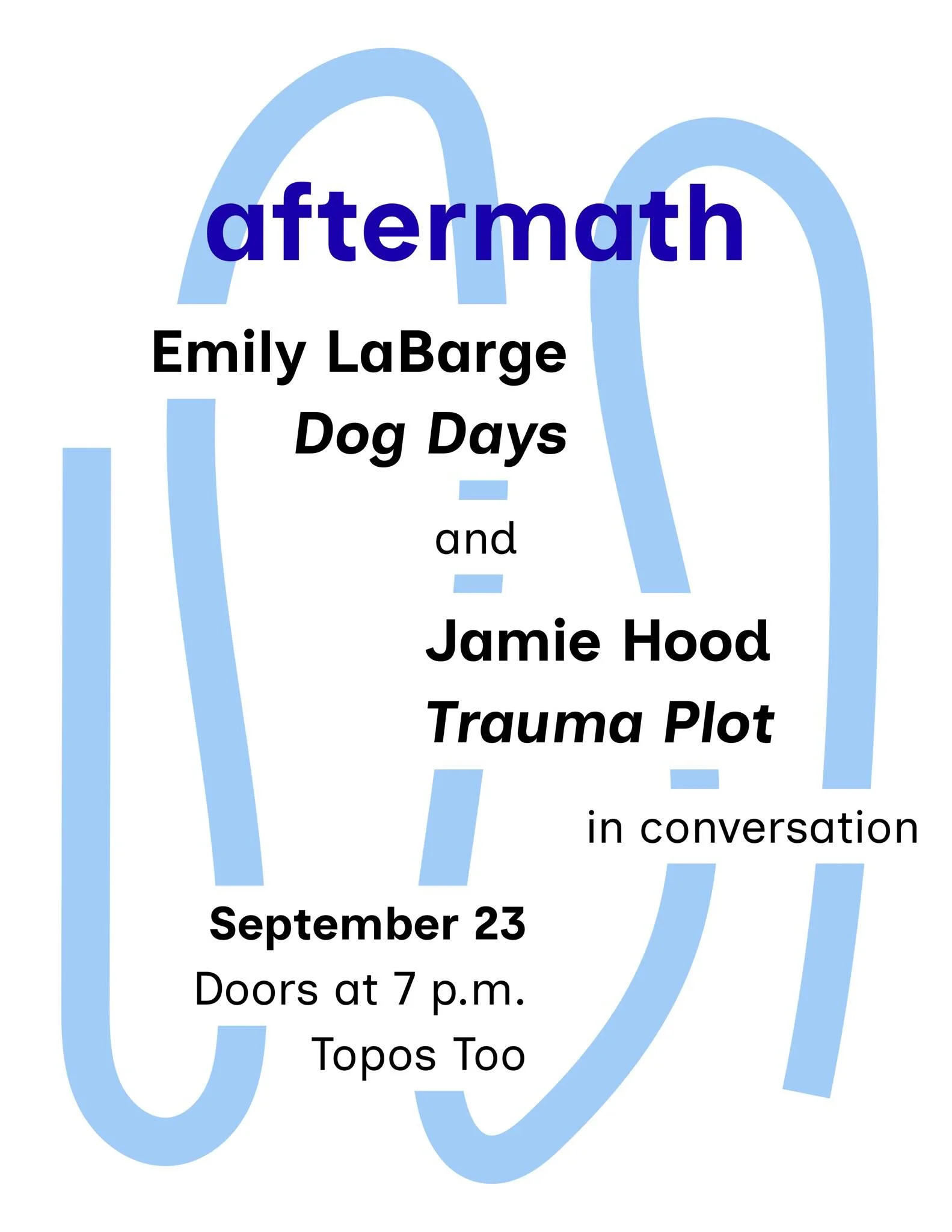
On Wednesday, September 23, at 7 p.m., join Emily LaBarge (Dog Days) and Jamie Hood (Trauma Plot) for a conversation about their most recent books, and the aftermaths in which they were written, at Topos Too in Ridgewood, NYC.
Emily LaBarge is a Canadian writer based in London. Her essays and criticism have appeared in Granta, The London Review of Books, Artforum, Bookforum, Frieze, and The Paris Review, among others. She is a regular contributor to The New York Times and 4Columns. Dog Days is her first book.
Jamie Hood is the author of Trauma Plot: A Life; how to be a good girl, one of Vogue’s Best Books of 2020; and regards, marcel, a monthly newsletter on Proust and other miscellany. Her essays and criticism have appeared in The Baffler, Bookforum, The Nation, Los Angeles Review of Books, The New Inquiry, The Drift, and elsewhere. She lives in Brooklyn.
In 2009, Emily LaBarge and her family were held hostage at gunpoint while on vacation. A crocheted blanket was placed over her head while Mrs. Doubtfire and “Agnus Dei” played on repeat. In the years that follow, a therapist encourages her to lie in exactly the same position, “just like how it happened, for as long as it happened, and for as long as it takes until the pain comes out”—otherwise it will never leave. She tries to find “the good story”: the version that doesn’t make anyone uncomfortable, the short-enough one, the one with a moral or punchline. But what happens to the things the good story leaves out?
An electrifying synthesis of memoir, criticism, and psychoanalytic theory that draws upon film and writing from Mulholland Drive to It’s a Wonderful Life, Virginia Woolf to Alice Munro, Dog Days channels form into political inquiry: interrogating how language and institutional structures constrain and distort our understandings of trauma, violence, and care. The result is not only a prose work but also a practice: an insistence on more radical, more complex forms of engagement that move beyond our desire for narrative containment, into a place where writing becomes a way of surviving.
“An incandescent book, a landmark in how to bring language to bear on the unspeakable. Beautiful, uncompromising, rigorous and totally original.—Olivia Laing, author of The Lonely City