
Postcard from Berlin
Mariana Dimópulos
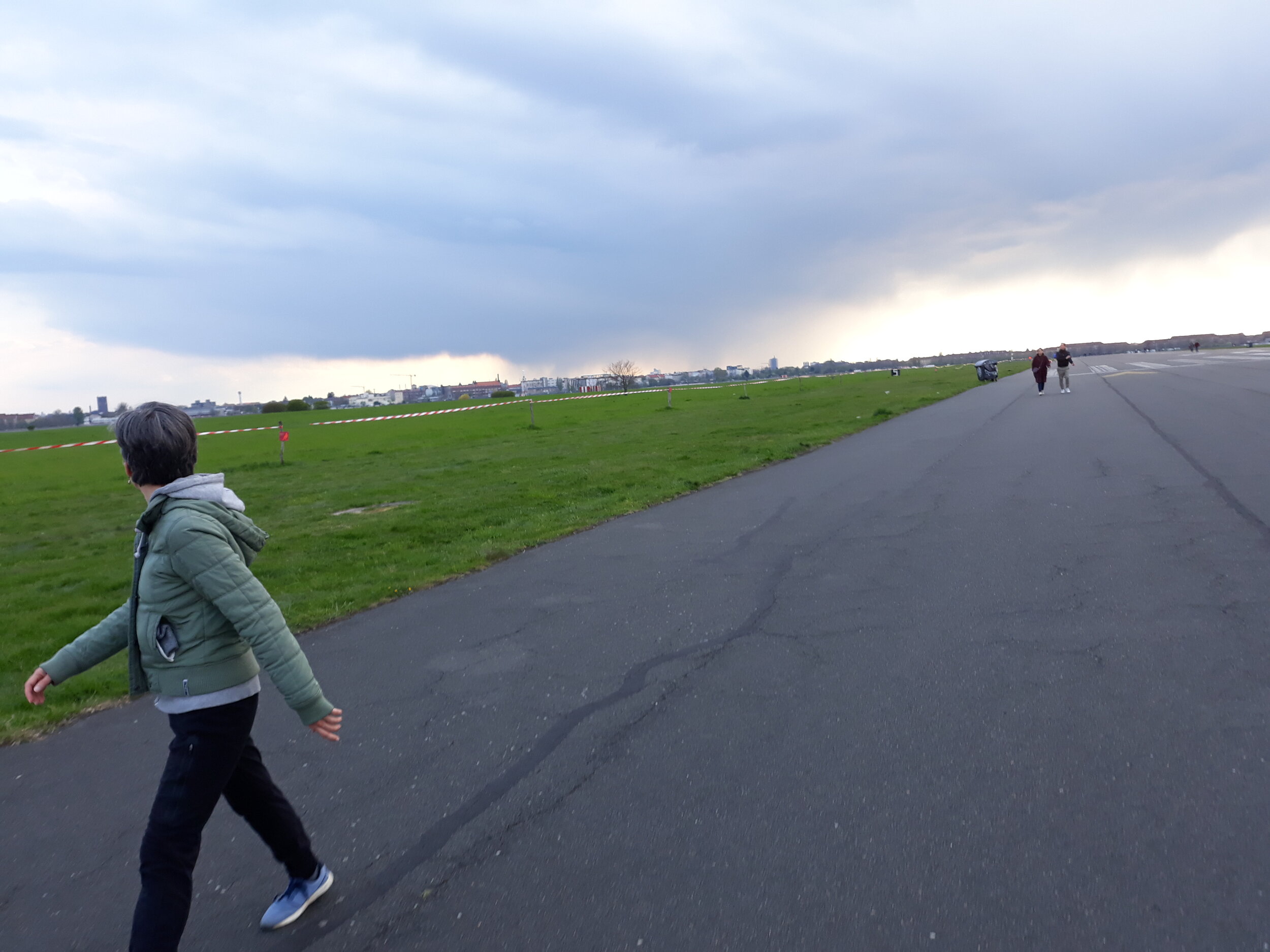
Go walking, choose a backdrop, get distracted: an equation that proves useful every day. You need only an acceptable indoor space for working, and a sky bare of storms for going out. I try to satisfy this equation daily, for an hour, no matter where I am. For years the scenery might be stable, and you try not to get annoyed by the sameness, and you find new events in the regular flow of things. A car moves too slowly on the avenue, a woman has lost a shoe. Children and animals provide an occasion for joy because of their general ability to be curious. If you have a partner by your side you may ask: have you seen that child, those dogs, the lost shoe? But sometimes restlessness, or a job offer, or mere chance of any kind makes us face a new setting. Now the familiar river coast in Buenos Aires, with its failed infinitude, the leaning trees, the murky waters, belong to the past. You have moved out, but the equation still needs to be satisfied. From now on, a mountain provides a walkable, gentle slope for the hiker; or a ten-minute stroll reveals a park with people and faces and clothes that are happily unfamiliar. This new outdoor life will be brilliant in its newness for some time, then weeks of regularity will provide habituation. But in some places, you have the suspicion that this will never happen. One of these places is Berlin, where the overlay of its past allows for more backdrops in the equation. A former airport is now a park that will never be a proper park. An old state border is now gone but it seems it will never be gone. Many open areas were filled in, but cranes still emerge, as if the construction sites will never stop. Of course, never is a huge word and no city deserves this suspicion. Berlin too will be finished and fairly boring someday. In the meantime, how nice is its uncertainty.
Mariana Dimópulos is the author of All My Goodbyes and Imminence.

Mariana Dimópulos
Translated from the Spanish by Alice Whitmore
“In her elegant short novel, Dimópulos explores the compromises a human being makes in taking on the identity and social role of a woman. With its caustic vignettes of male vanity and its subtle self-mockery, Imminence is playful on the surface, dark and disturbing in its depths.” —J.M. Coetzee, winner of the Nobel Prize for Literature
A new mother holds her month-old son for the first time, but her body betrays her with an absence of feeling. Disoriented, she wanders with her partner around their plant-filled Buenos Aires apartment. Set over the course of an evening, and a lifetime, Imminence shifts seamlessly between the present and the past. Little by little, her world begins to unravel.
In a dreamlike space composed of overlapping vignettes, Irina retraces the mirrored paths of a life filled with images that swell and recede, recalling the intimacies and anxieties she has shared with her female friends, and with her male lovers: Pedro, Ivan, and the sinister Cousin. Feeling herself caught in a web of obligations, she insists time and again: “I’m not a woman.”
Mariana Dimópulos’s mesmerizing novel reinforces her standing as one of the most expressive and inventive contemporary Latin American writers.